Last Updated: November 4, 2026
Quick Summary
Event branding is the coordinated use of visual identity, signage, spaces and digital touchpoints to make an event feel like it belongs to one organisation. Build it as a system: map at least one brand touchpoint to each stage of the attendee journey, from branded invitations to repurposed post-event content.
- Keep one visual identity across every touchpoint and map the guest journey before printing any banner.
- Design the stage for the camera: logo at a height that works in wide shots, no busy patterns.
- Build a reusable kit with logo files, colour codes, typography rules, signage templates and a usage guide.
- Track photo shares, hashtag volume, app logins and survey recall to measure branding ROI.
- Spend where guests pause and photograph, and simplify corridors and back-of-house.
Table of Contents
- Why Corporate Event Branding Ideas for 2026 Need a Strategy Behind Them
- Corporate Event Branding Examples That Show What Works
- Building an Event Branding Strategy Around the Attendee Journey
- What Goes Into a Practical Event Branding Kit
- Branded Photo Booth Ideas That Extend Your Reach
- Digital Touchpoints and Event Technology That Carry Your Brand
- Measuring Event Branding ROI and Repurposing Content After the Event
- Accessible, Budget-Smart Branding That Still Looks Considered
- Frequently Asked Questions
Why Corporate Event Branding Ideas for 2026 Need a Strategy Behind Them
Most event branding fails for one reason: it starts with a logo and ends with a banner. The companies getting it right in 2026 treat event branding as a system, not a decoration budget.
Event branding is the coordinated use of visual identity, signage, spaces and digital touchpoints to make an event feel like it belongs to one organisation. It covers everything a guest sees, touches or shares.
A clear approach matters because scattered branding creates noise. Consistent branding creates recall. Guests remember the event that felt deliberate.
Three principles separate the strong from the forgettable:
- One visual identity across every touchpoint
- A journey mapped before the first banner is printed
- A plan for what happens to the content afterwards
Get these right and the rest becomes execution. Miss them and you’re paying for signage nobody photographs.
Corporate Event Branding Examples That Show What Works
Strong corporate event branding examples share a pattern: they guide guests without shouting at them. Here are the three zones that do the heaviest lifting.
Entrance and Welcome Area Branding
The entrance sets the tone in seconds. A custom backdrop, a greeter with a branded lanyard, and a clean registration desk do more than a wall of banners.
Keep it simple. One focal point, clear sightlines, and space for guests to pause and take a photo. That pause is where brand recall starts.
Directional and Wayfinding Signage
Wayfinding is the most underrated piece of event signage. Guests who can’t find the session room, the toilets or the networking area get frustrated, and frustration is what they remember.
Use consistent colour coding across floor decals, freestanding signs and digital displays. Match the colour palette to your corporate identity so the signs feel like part of the event, not an afterthought.
Stage and Backdrop Design
The stage is your most photographed surface. Design it for the camera, not just the room.
- Keep the logo at a height that works in wide shots
- Avoid busy patterns that fight on video
- Build in a custom backdrop with depth for speaker photos
A stage that photographs well turns every speaker selfie into free brand awareness.
Building an Event Branding Strategy Around the Attendee Journey
An event branding strategy maps your brand touchpoints to what an attendee is actually doing at each moment. It’s a sequence, not a checklist.
Here’s how we’d build one:
- Before the event: branded invitations, event app, email sequences
- Arrival: welcome area, registration, first photo moment
- During: wayfinding, stage production, networking area, interactive display
- Departure: thank-you touchpoints and a reason to share
- After: repurposed content and follow-up
Each stage needs at least one brand touchpoint. The strongest events have two or three.
The mistake we see most often is overloading the arrival and neglecting the departure. Guests leave with whatever you hand them last. Make that count.
Map at least one brand touchpoint to each stage of the attendee journey.
| Journey stage | Brand touchpoints |
|---|---|
| Before the event | Branded invitations, event app, email sequences |
| Arrival | Welcome area, registration, first photo moment |
| During | Wayfinding, stage production, networking area, interactive display |
| Departure | Thank-you touchpoints and a reason to share |
| After | Repurposed content and follow-up |
What Goes Into a Practical Event Branding Kit
An event branding kit is the physical and digital pack that keeps every touchpoint consistent. Build it once, reuse it across events.
A working kit includes:
- Logo files in print and screen formats
- Colour palette with exact codes for print and digital
- Typography rules for headings and body text
- Template signage for wayfinding and stage use
- Event collateral templates: programs, name badges, menus
- A short usage guide so suppliers stay on brand
The usage guide is the part most teams skip. It’s also the part that saves you when a last-minute supplier prints something off-brand.
If you need a corporate photobooth provider who can work inside that kit, explore the corporate photobooth packages available for business events.
Branded Photo Booth Ideas That Extend Your Reach
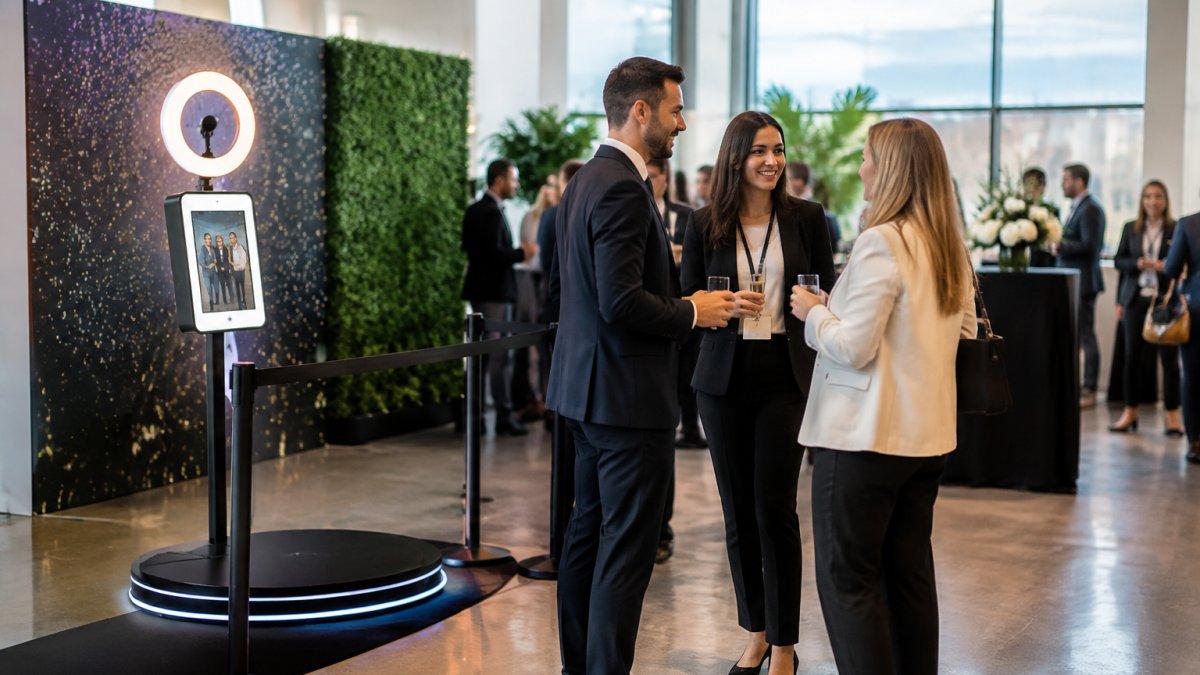
A branded photo booth turns guests into distributors. Every photo shared carries your visual identity into feeds you’d never reach through paid media.
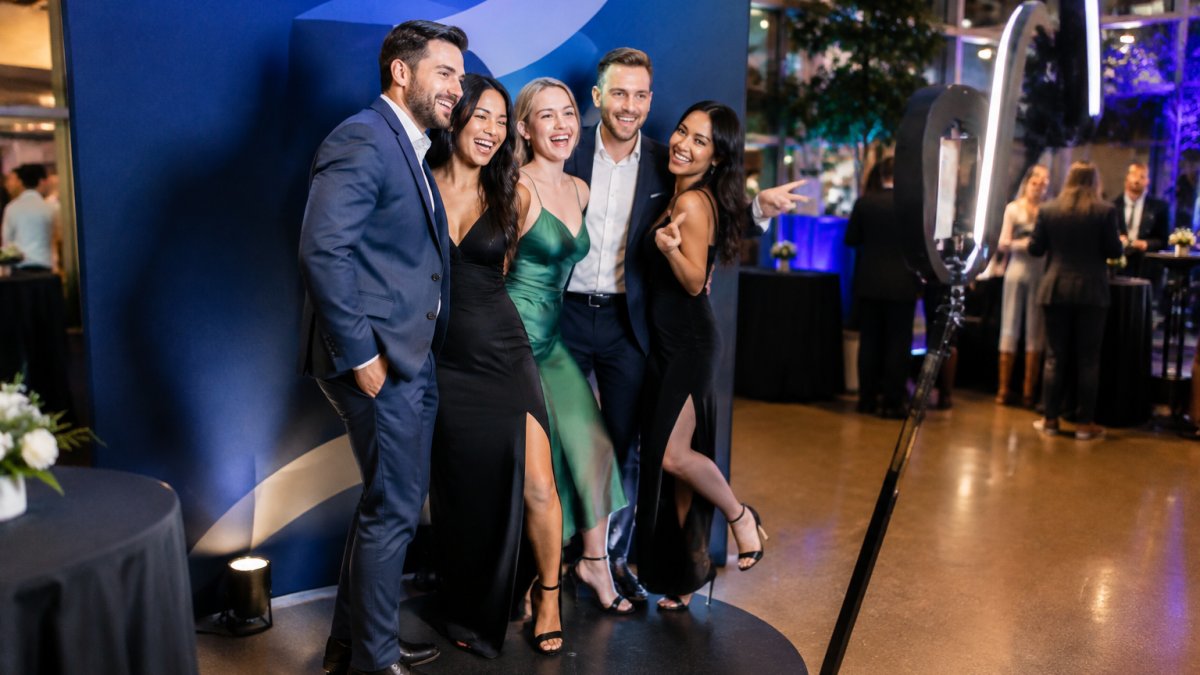
These branded photo booth ideas work because they’re built around sharing:
- Custom backdrop in your event theme and colours
- Branded photo frames with the event hashtag
- On-screen prompts that match your brand storytelling
- Instant share stations for social media
For a step-by-step method to put your event brand onto a booth, follow this branding guide for corporate photobooths.
Digital Touchpoints and Event Technology That Carry Your Brand
Event technology is where brand consistency usually breaks. The event app looks one way, the check-in screens another, and the social wall a third.
Treat every screen as a brand surface with a job to do. A practical way to structure this is a three-layer digital brand system:
- Identity layer: locked colour codes (hex for screen, CMYK for print), approved logo lockups, and a type scale that survives at 3 metres on a LED wall and at 30 centimetres on a phone.
- Content layer: a shared asset library with pre-approved templates for welcome screens, session lower-thirds, countdown timers and social walls, so a last-minute change doesn’t produce an off-brand slide.
- Data layer: one source of truth for the event schedule, speaker names and sponsor logos, pushed to the app, the signage player and the check-in kiosks so they never contradict each other.
Digital signage is the highest-leverage piece because it is the only touchpoint you can change mid-event.
Event apps carry the brand through registration, session schedules and networking prompts. The mistake is treating the app as an IT project rather than a brand project.
Immersive technology and simulators are appearing more often at larger corporate events, but they are only worth the spend if the experience is branded at the point of capture. Physical installations should mirror this digital consistency, as creative corporate balloon designs offer a tactile way to reinforce your visual identity throughout the venue.
Watch out: if you don’t brief your AV supplier on the brand kit before load-in, they may default to their own templates and slides may need fixing instead of welcoming guests.
If you want proven formats to extend your brand beyond signage, review these interactive marketing ideas for brands.
Measuring Event Branding ROI and Repurposing Content After the Event
Branding ROI is measurable if you decide what to track before the event. Most teams don’t, which is why the post-event report is thin.
Track engagement metrics that tie back to brand awareness:
- Photo and content shares per guest
- Hashtag and mention volume during and after the event
- Event app logins and session saves
- Post-event survey recall of sponsors and brand messages
Then repurpose what you captured. Guest photos, speaker shots and behind-the-scenes clips become next quarter’s social content. That’s where the cost per impression drops sharply.
Watch out: if you don’t secure photo permissions at registration, most of that content becomes unusable. Build consent into the sign-up flow.
Accessible, Budget-Smart Branding That Still Looks Considered
Most articles on corporate event branding treat accessibility as an afterthought and budget as a reason to do less. Neither is true.
Start with accessibility because it changes design decisions early, when they are cheap to make.
- Colour contrast: body text and wayfinding need a contrast ratio that stays legible under event lighting and on phone screens. Check every brand colour pairing before it goes to print, not after.
- Type legibility: minimum body sizes on signage, generous line spacing, and no all-caps paragraphs. Neurodivergent attendees and older guests both benefit from plain, well-spaced type.
- Wayfinding clarity: consistent iconography, colour coding that doesn’t rely on red/green alone, and signs placed at decision points rather than at the end of corridors.
- Sensory consideration: quiet zones, clear sightlines and avoiding strobing or high-frequency motion on digital screens. A branded lounge can double as a low-stimulation space if you plan it that way.
- Digital accessibility: captions on stage content, alt text on app images, and readable font sizes in the event app.
Accessibility also happens to be good environmental branding. Legible, high-contrast, calm spaces feel more premium than busy ones. The restraint that accessibility forces is the same restraint that makes a brand look considered.
On budget, the principle is concentration, not compromise. Spend where guests pause and photograph, and simplify everywhere else.
- Reuse one strong backdrop across multiple zones rather than commissioning several weaker ones.
- Print in one or two colours instead of full colour everywhere; a single-colour wayfinding system often reads more confidently than a busy full-colour one.
- Invest in the entrance and stage, go simple in corridors and back-of-house.
- Use digital screens for messaging you might need to change, so you don’t reprint signage when the schedule shifts.
- Build a reusable kit of frames, templates and signage that carries across events rather than buying one-off assets each time.
Watch out: cutting accessibility features to save budget is a false economy.
For creative setups you can adapt, browse photobooth ideas for memorable events. And to budget without guesswork, check the photobooth hire price guide before you commit.
Frequently Asked Questions
What is event branding and why does it matter for a corporate event?
Event branding is how your company’s visual identity, tone and message carry through every part of an event, from the welcome signage and stage backdrop to the event app and photo booth. It matters because consistent branding builds brand recall and makes the event feel intentional rather than generic. A clear event branding strategy ties colour palette, logo placement and messaging to the attendee journey, so guests experience your brand at registration, during sessions and after they leave.
What should be included in an event branding kit?
A practical event branding kit typically covers logo files in multiple formats, your colour palette with hex codes, approved fonts, templates for signage and name badges, social media frames, and guidelines for photo booth overlays and backdrops. Include accessibility notes such as minimum text sizes and contrast ratios so suppliers apply your brand correctly. A written one-page style guide saves time with printers, AV teams and photographers, and keeps brand consistency across every touchpoint.
How can a branded photo booth support corporate event branding?
A branded photo booth turns guests into content creators. Custom backdrops, branded photo overlays and on-screen prompts carry your visual identity into every image, and guests share those images on social media, extending brand awareness well beyond the room. Choose a provider that offers custom fabrication for backdrops and overlays, and confirm they can match your colour palette. Pricing depends on customisation, guest numbers and dates, so request a quote for current rates.
How do you measure whether corporate event branding worked?
Measure branding success with engagement metrics rather than impressions alone. Track photo booth usage counts, social media shares and hashtag reach, event app logins, session attendance and post-event survey responses about brand recall. Compare these against your pre-event goals, such as a target number of shared images or registrations. Post-event content repurposing, like reusing booth photos in follow-up campaigns, adds measurable value and gives you data-driven marketing insights for the next event.
Branding an event well takes more than good taste. It takes a system, a journey map, and a partner who delivers on the day. Click Shoot Entertainment brings 12 years of experience, premium 360 photobooth technology, and customisable features that fit your event theme, all backed by a customer-focused team that treats your brand like its own. Get started with Click Shoot Entertainment and turn your next corporate event into content your guests share for months.