
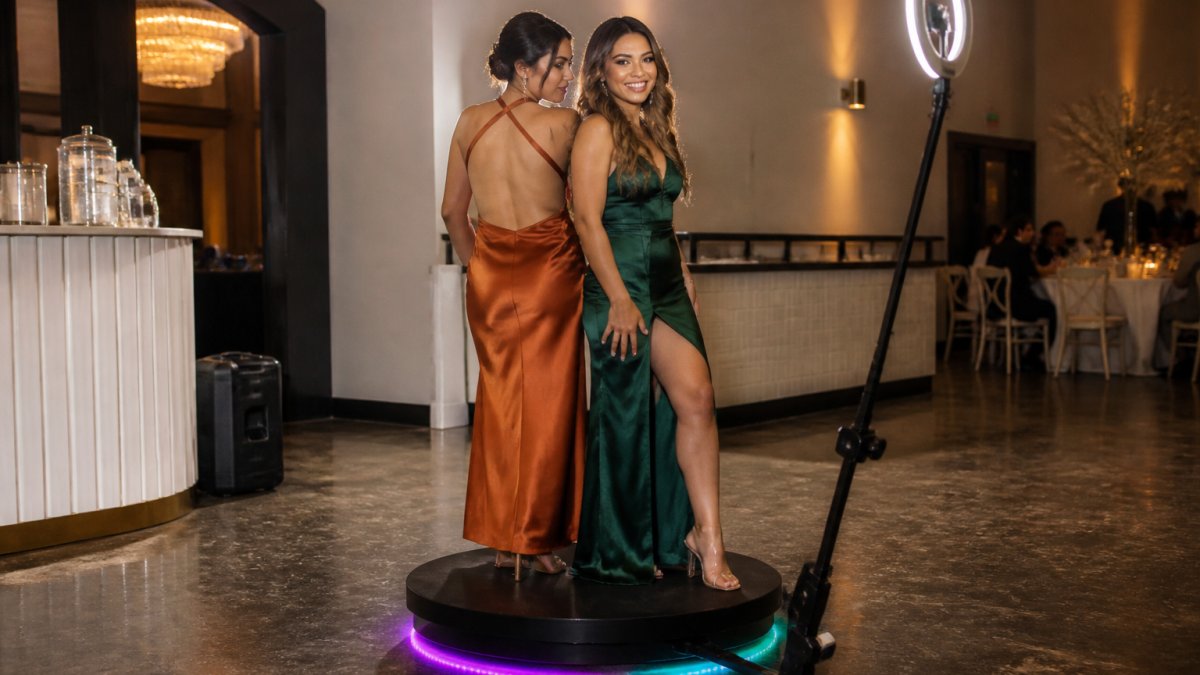
Last Updated: November 1, 2026
Quick Summary
A 360 photo booth is worth it when your guest list is social, the room has space and even light, and shareable video is the goal. It is not worth it for small, seated or formal events where a printed keepsake or a roaming photographer fits the brief better.
- A 360 setup takes two to four people per turn and cycles groups faster than hosts expect.
- Ask for equipment, software, transport, labour, props and prints as separate quote lines.
- Plan a clear three-by-three-metre footprint with even light and safe walkway space.
- A guest list where at least 60 people will be up and moving gives the booth a queue.
- A cheap, unstaffed rig is the most common source of disappointment.
Table of Contents
- What a 360 Photo Booth Actually Delivers at an Event
- 360 Photo Booth Pros and Cons for Event Hosts
- 360 Photo Booth Hire Cost: What Drives the Price
- 360 Photo Booth Space Requirements and Venue Checks
- 360 Photo Booth vs Traditional Photo Booth: Which Fits Your Event
- When a 360 Booth Is Worth It and When It Is Not
- Book a 360 Photo Booth for Your Next Melbourne Event
- Frequently Asked Questions
What a 360 Photo Booth Actually Delivers at an Event
A 360 photo booth is a camera mounted on a rotating arm that circles a small platform while guests pose, producing a slow-motion video clip that can be shared within minutes. That is the whole idea, and it is a good one: the platform becomes a stage, and the clip becomes the souvenir.
The draw is not the photo. It is the moment of performance, and the crowd that gathers to watch it happen.
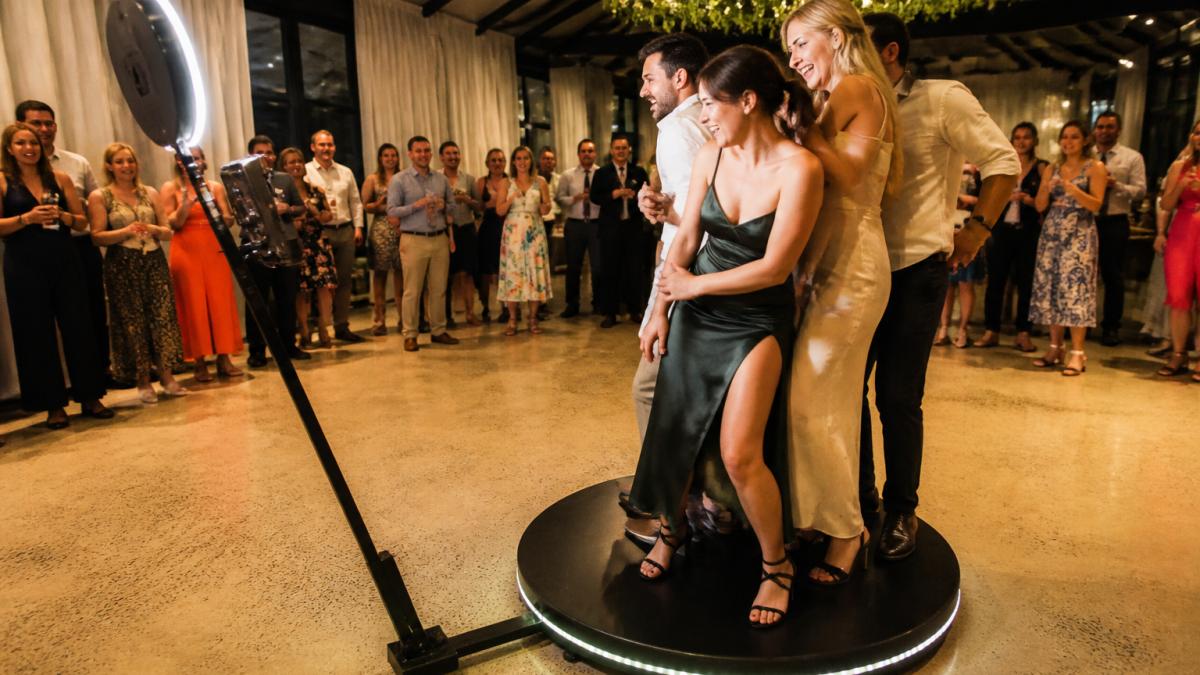
What guests actually receive is a short video clip, usually a few seconds long, filmed at high frame rates so the movement looks smooth and slow. Overlay your names, a date or a logo, and the clip is ready to send. That shareable content is why the format caught on: it looks expensive, it films well, and it travels on social media without prompting.
The practical difference from a static booth is throughput. A 360 setup can take two to four people at a time, and the rotation is quick. Groups cycle through faster than most hosts expect.
360 Photo Booth Pros and Cons for Event Hosts
The honest summary: a 360 booth is a strong entertainment choice and a weaker choice for anyone who mainly wants printed keepsakes. Weigh the two lists below before you commit.
Pros
- High visual impact that draws a crowd and keeps guests engaged
- Shareable content guests post themselves, giving your event free brand exposure
- Customisable features to fit event themes
- Works for groups, not just couples, so it suits mixed guest lists
- An attendant-managed setup means guests need no instructions
Cons
- Needs more floor space than a traditional booth
- No physical print unless you add one
- Lighting matters more than most venues realise
- Costs more per hour than a basic selfie booth
- A novelty risk if the guest list is small or seated for most of the night
The novelty point deserves a straight answer. The format holds attention when there is a queue and a crowd. With 40 guests in a small room, the energy depends on timing. Place it near the bar or dance floor and it stays busy; tuck it in a side room and it dies.
360 Photo Booth Hire Cost: What Drives the Price
Pricing depends on quantity, dates and delivery, so we recommend contacting Click Shoot Entertainment through the website for current prices or a quote. Here is the itemised structure behind a typical quote.
What is actually in a hire quote
A transparent quote should break down into these lines. Ask for each one separately, because a headline price that bundles them hides where the margin sits.
-
Equipment hire. The rig itself, rotating arm, camera, lighting, platform, and the tablet or screen that runs the capture and sharing flow.
-
Software and overlays. Capture software, the slow-motion processing, branded overlay templates, and the sharing or QR delivery setup. Custom overlay design is often a separate line from stock templates.
-
Transport and logistics. Delivery to the venue, bump-in and bump-out, and any parking or loading-zone costs. Travel beyond a set radius is commonly charged per kilometre.
-
Attendant labour. Setup, operation for the full hire window, and pack-down. A second attendant for large guest counts is an add-on, not a given.
-
Props and backdrop. Themed backdrops, signage and props take preparation time and are frequently priced as extras.
-
Consumables and prints. If you add a print option, paper and ink are a per-print or per-hour cost on top of the base hire.
Travel, extra hours on the night, a second attendant and print add-ons are the usual extras. Ask what is excluded before you compare two quotes, because a cheaper headline is often a shorter window with fewer inclusions.
The drivers that move the number most
- Attendant and setup time. Delivery, build, staffing and pack-down are labour, and labour is the line that scales with venue complexity, stairs, lifts and long walks from the loading bay all add time.
- Customisation. Branded overlays, props and themed backdrops take preparation before the event, not just on the night.
- Guest count and throughput. Bigger events may need a second attendant or extended hours to keep the queue moving.
Hire versus buying: the total-cost view
Hosts sometimes ask whether buying a 360 booth is cheaper than hiring for a one-off event. Run the numbers on total cost, not sticker price, including transport, maintenance, software, insurance and labour.
360 Photo Booth Space Requirements and Venue Checks
Plan for a clear footprint plus a safe walkway around the platform. Ceiling height matters too, as the camera arm sits above head height.
Venue checks worth doing before you book:
- Confirm floor loading and whether the platform sits on carpet, timber or concrete
- Check power access within reach of the setup
- Ask about bump-in times and lift access
- Confirm the booth will not block fire exits or bar service
- Check whether the venue has its own lighting that will wash out the platform
Watch out: a dark corner with one downlight will produce flat, grainy footage. The best clips come from a spot with even light and a backdrop worth filming.
360 Photo Booth vs Traditional Photo Booth: Which Fits Your Event
A traditional photo booth gives you prints and a physical keepsake. A 360 booth gives you video and reach. Pick based on what your guests will value more.
| Feature | 360 Photo Booth | Traditional Photo Booth |
|---|---|---|
| Output | Slow-motion video clip | Printed photo strips |
| Group size | Two to four per turn | Two to six per turn |
| Space needed | Larger, open footprint | Compact, enclosed |
| Sharing | Instant, social-first | Handed out on the night |
| Best for | Weddings, launches, parties | Weddings, formals, family events |
| Branding | Overlays on video | Printed logos and frames |
Mirror booths sit between the two: touchscreen interaction with a printed photo. A selfie frame is the budget option, and it shows.
When a 360 Booth Is Worth It and When It Is Not
“Worth it” means two different things depending on who is asking. An event host is weighing entertainment value against the hire fee. An operator or venue is weighing a capital purchase against booking revenue. Most articles blur the two; keep them separate and the decision becomes much clearer.
For event hosts: a decision framework
Work through these questions in order. The first “no” is usually the deciding one.
- Will enough guests be standing and mingling? A 360 booth feeds on foot traffic and a watching crowd. A seated, speech-heavy dinner starves it. As a rough guide, a guest list where at least 60 people will be up and moving gives the booth a queue to work with; below that, the energy depends heavily on placement.
- Is there a clear three-by-three-metre footprint with even light? If the only space is a dark corner with one downlight, the footage will be flat and grainy and the format loses its main advantage.
- Do you want video and reach, or a physical keepsake? A 360 booth delivers a shareable clip. If your guests will treasure a printed strip more, a traditional or mirror booth is the better spend.
- Is the content on-brand or on-theme? For corporate activations and branded events, custom overlays turn the clip into earned reach. For a formal seated event, that reach matters less.
- Does the budget stretch to a staffed, well-lit setup? A cheap, unstaffed rig is the most common source of disappointment. If the budget only covers the bottom of the market, a roaming photographer or a selfie station may deliver more reliable value.
The alternatives, compared by goal
- Traditional photo booth, best when prints and a physical keepsake are the point. Compact footprint, lower hourly cost, less crowd-drawing spectacle.
- Mirror booth, touchscreen interaction plus a printed photo; sits between the two formats and suits guests who want to engage with a screen rather than perform for a camera arm.
- Selfie station or roaming photographer, the budget and flexibility options. A roaming photographer captures the room without a fixed footprint; a selfie station needs no attendant but generates less shareable video.
- 360 booth, best when the goal is a spectacle that produces social-ready video and draws a crowd.
A 360 booth is worth it for hosts when the guest list is social, the room has space and light, and shareable video is the goal. It is not worth it for small, seated or formal events where a printed keepsake or a roaming photographer fits the brief better.
For operators: the break-even question
If you are considering buying a booth to hire out, the worth-it question is arithmetic, not vibes. Build a simple model with explicit assumptions: purchase and setup cost, software subscription, insurance, transport per booking, attendant labour per event, maintenance reserve, and your average booking fee and bookings per month. Break-even is the number of bookings that covers fixed costs plus per-event costs. The trap is assuming peak-season booking rates all year; model a quiet month as well as a busy one.
A simple test for hosts: will at least 60 guests be standing, mingling and looking for something to do? If yes, book it. If no, consider a traditional booth or a roaming photographer instead.
Book a 360 Photo Booth for Your Next Melbourne Event
We built Click Shoot Entertainment to deliver a reliable experience. Our team brings premium, high-quality equipment and customisable features to fit event themes. With 12 years of industry experience, we deliver a seamless and engaging experience for your guests.
Get started with Click Shoot Entertainment and give your guests something worth filming. Explore our customisable photobooth experiences and lock in your date.
Frequently Asked Questions
How much room is needed for a 360 photo booth?
Plan for a clear area of roughly 3 by 3 metres to 4 by 4 metres. That covers the rotating platform plus the camera arm’s swing and a comfortable queue zone. Ceiling height matters too, so check with the venue before booking. Share your floor plan with the provider early; they can confirm whether a 360 photo booth space requirements fit your room and flag any access issues such as stairs or narrow doorways.
Is a 360 photo booth worth it for a smaller event?
It can be. Smaller gatherings of 40 to 60 guests often get more use per person because queues stay short and everyone tries it. The trade-off is cost per head, which rises as guest numbers fall. Decide based on whether you want a shared activity that gets people mingling. If your priority is a steady stream of shareable content and a focal point for the room, a 360 photo booth still earns its place.
What are the pros and cons of a 360 photo booth?
Pros: slow-motion video clips that guests share on social media, strong visual impact, and a draw that keeps people engaged across the night. Cons: it needs more floor space than a traditional booth. Weigh these against your guest count and venue. For brand activations, the shareable content and logo placement often justify the spend; for a quiet dinner, it may be more than you need.
How many people can use a 360 photo booth at once?
Platform capacity depends on the platform size and the arm’s clearance. Ask your provider for the platform capacity and expected clip length before you book, then plan your run sheet so the booth is available during peak social hours.